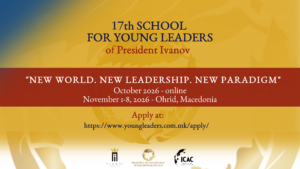
17th School for Young Leaders of President Ivanov
GENERAL TOPIC: “New World. New Leadership. New Pragmatism.”
ABOUT
The School for Young Leaders is a project of the President of the Republic of Macedonia 2009-2019, Dr. Gjorge Ivanov, primarily initiated in his first electoral program, following his idea and vision to enable young people from Macedonia and from abroad to upgrade and improve their skills, to develop their creativity and managerial capacities. The first School was organized in Ohrid in August 2010.
625 young people with various academic and professional focuses from all over the world took part in the past 16 trainings. The sixteen generations of participants in the School for Young Leaders had the opportunity to attend lectures by 450 renowned lecturers from the Republic of Macedonia, Europe, and the world.
In 2018, the World Business Angels Investment Forum recognized the School for Young Leaders as the Best Socially Responsible Project in Europe for 2017.
🌍🎓 MISSION
The mission of the School is to stimulate positive values in the young intellectual elite and future political, cultural, and economic leaders, primarily of our country, but also to encourage and enhance their capacity for taking on global challenges, international competition, and cultural and religious diversities.
🙋♂️🙋♀️ PARTICIPANTS
The Program is intended for young people under 35 years of age who have completed higher education, including both graduates and professionals with work experience. Participants are expected to demonstrate a willingness to develop and refine their leadership skills and to contribute to the positive development of society and the environment in which they live and work.
🗣️💼 PROGRAM
The program of the 17th School for Young Leaders of President Ivanov is designed to provide participants with knowledge, skills, and practical experience relevant to leadership in a rapidly changing world. Through lectures, discussions, workshops, mentorship, real-life case studies, and collaborative activities, participants will have the opportunity to explore different dimensions of leadership and gain insights from distinguished experts and practitioners from Macedonia and abroad.
The School’s program includes:
- Interactive lectures delivered by renowned speakers from academia, diplomacy, business, public service, and civil society;
- Panel discussions addressing topics related to the general theme of the School, “New World. New Leadership. New Pragmatism.”;
- Workshops focused on developing practical leadership and problem-solving skills;
- Mentorship sessions with members of the School’s alumni community;
- Soft skills training, including communication, teamwork, negotiation, and public speaking;
- Group project work aimed at fostering collaboration, innovation, and strategic thinking;
- Presentations and discussions that encourage the exchange of ideas, experiences, and perspectives.
The program is tailored to the interests and needs of young leaders and addresses contemporary challenges and opportunities at the local, regional, and global levels.
Through its activities, the School seeks to encourage participants to think critically, act responsibly, and lead with confidence. It aims to strengthen their ability to initiate and manage change, develop creative and innovative solutions, build meaningful partnerships, and respond effectively to the challenges of an increasingly interconnected world. At the same time, participants are encouraged to invest in their personal and professional development and to contribute positively to their communities and societies.
🌟✌️ GENERAL TOPIC
“New World. New Leadership. New Pragmatism.”
“New World. New Leadership. New Pragmatism.” reflects the need for a new generation of leaders capable of responding to the profound transformations shaping our world. Rapid technological advancement, geopolitical shifts, environmental challenges, and evolving social dynamics are redefining the way societies function and interact. In such a context, leadership requires not only vision, but also the ability to translate ideas into practical and meaningful action.
New World refers to the emerging global reality shaped by technological innovation, artificial intelligence, digital connectivity, demographic changes, environmental pressures, and shifting geopolitical balances. It is a world characterized by unprecedented interdependence, where local decisions have global consequences and where opportunities and challenges transcend national borders. Understanding this new reality requires openness, adaptability, and a willingness to engage with complexity.
New Leadership represents a shift from traditional, hierarchical models of authority toward more collaborative, inclusive, and purpose-driven approaches. The leaders of the future must be capable of inspiring trust, fostering dialogue, managing diversity, and building partnerships across cultures, sectors, and generations. They must combine strategic thinking with emotional intelligence, integrity with innovation, and vision with responsibility.
New Pragmatism emphasizes the ability to transform ideas into action and values into tangible results. In a rapidly changing world, effective leadership requires practical solutions, informed decision-making, and the courage to act while remaining guided by ethical principles. Pragmatism does not mean abandoning ideals; rather, it means pursuing them through realistic, achievable, and sustainable approaches that create meaningful impact for individuals, communities, and societies.
Together, these three concepts define a framework for leadership in the twenty-first century. They call upon young leaders to understand the realities of a changing world, embrace new approaches to leadership, and develop the practical skills needed to address complex challenges and seize emerging opportunities.
The new generation of leaders must be prepared to navigate uncertainty, bridge differences, and build consensus across cultures, sectors, and disciplines. In an increasingly interconnected world, dialogue, cultural understanding, and international cooperation remain essential for addressing shared challenges and fostering sustainable development.
At the same time, new leadership requires a long-term perspective. Future leaders must recognize their responsibility not only to achieve immediate results, but also to contribute to building more inclusive, resilient, and sustainable societies. Success should be measured not only by economic growth, but also by social cohesion, human dignity, environmental responsibility, and peace.
“New World. New Leadership. New Pragmatism.” is both a reflection of the realities of the twenty-first century and a call to action. It challenges young leaders to think critically, act responsibly, and lead effectively in a world of constant change. It invites them to become agents of positive transformation who can connect vision with action and principles with results.
In this spirit, the School for Young Leaders continues its mission of empowering young people to develop the knowledge, skills, and values necessary to lead in a complex world and to contribute meaningfully to the future of their societies and the global community.
🗓️🏨 DATE, TIME, PLACE, FORMAT
The 17th School for Young Leaders of President Ivanov will be organized in a hybrid format, combining online activities with an in-person program in Ohrid, Republic of Macedonia.
Mentorship Program
The first part of the School will consist of a mentorship program, which will take place throughout October 2026. Participants will work closely with mentors from the School’s alumni community through online sessions arranged directly with their mentors, with up to two meetings per week.
Online Lecture Series
The second part of the program will consist of online lectures held from October 26 to October 30, 2026. The lectures will take place online on working days after 17:00 CET and will feature distinguished speakers and experts from various fields.
Travel and Arrival
October 31, 2026, is designated as a travel and arrival day, allowing participants, particularly those traveling from abroad, to arrive in Ohrid and prepare for the residential part of the School.
In-Person Program in Ohrid
The third and final part of the School will take place from November 1 to November 8, 2026, at Hotel “Inex Olgica” in Ohrid, Republic of Macedonia. Participants will engage in a full-day program consisting of lectures, panel discussions, workshops, project work, networking activities, and presentations.
Together, these three components are designed to provide participants with a comprehensive leadership development experience that combines mentorship, knowledge-sharing, practical engagement, and international networking.
🙋♂️🙋♀️ CALL FOR PARTICIPANTS
The Call for participants is open until June 30th, 2026.